Thermal Mass Is Not the Same as Insulation
Many people confuse thermal mass with energy efficiency. They are not the same, and understanding the difference is essential when designing a comfortable, durable, and efficient home.
Carlos DaCosta
4/12/20265 min read
Why people often confuse the two — and why the difference matters
Few subjects in housing are discussed with more confidence and less clarity than thermal mass.
It is a term many people have heard, and often repeat, but not always with a full understanding of what it actually means. In many conversations about efficient housing, thermal mass is spoken of as though it were automatically a great advantage, and in some cases almost a complete solution in itself.
It is not.
Thermal mass can be useful, important, and in the right conditions highly effective. But it is not the same thing as insulation, and it is not the same thing as energy efficiency. Confusing these ideas can lead to poor decisions, disappointing building performance, and unrealistic expectations.
To understand how a home truly performs, it is important to understand what thermal mass is, what it does well, where it works best, and where it falls short.
What thermal mass really means
Thermal mass is the ability of a material to absorb, store, and release heat over time.
Any material that absorbs heat or cold has some thermal mass. The real question is not whether a material has thermal mass, but how much it has, how fast it absorbs temperature, how slowly it releases it, and under what conditions that process is useful.
Materials such as stone, earth, brick, and concrete all have thermal mass. They can absorb warmth and they can absorb coolness. But that does not automatically mean they make a building efficient.
That is where many people become confused.
Thermal mass is not insulation
Insulation and thermal mass do two different jobs.
Thermal mass stores heat.
Insulation slows heat transfer.
A heavy wall may absorb heat, but if that wall is not insulated, the heat can pass out again just as easily. In a cold climate, that means the heat you are paying to produce indoors may simply be drawn into the wall and gradually lost to the outside.
This is why a material can have good thermal mass properties and still perform poorly as an efficient wall by itself.
Concrete is a very good example. It is a dense material and can store heat. But concrete on its own is not a good insulator. A relatively thin concrete wall, such as the kind often used in ordinary construction, does not automatically create an efficient home. Without proper insulation, it can become part of the heat-loss problem rather than the solution.
Why concrete walls are often misunderstood
Many people assume that because concrete feels solid, heavy, and substantial, it must also be highly efficient.
That is not necessarily true.
A concrete wall only a few inches thick may absorb heat from the interior, but in cold weather it can also lose that heat outward far too quickly if it is exposed directly to outside temperatures. The wall may have mass, but it does not have enough insulating resistance to stop heat transfer effectively.
In other words, thermal mass alone is not enough.
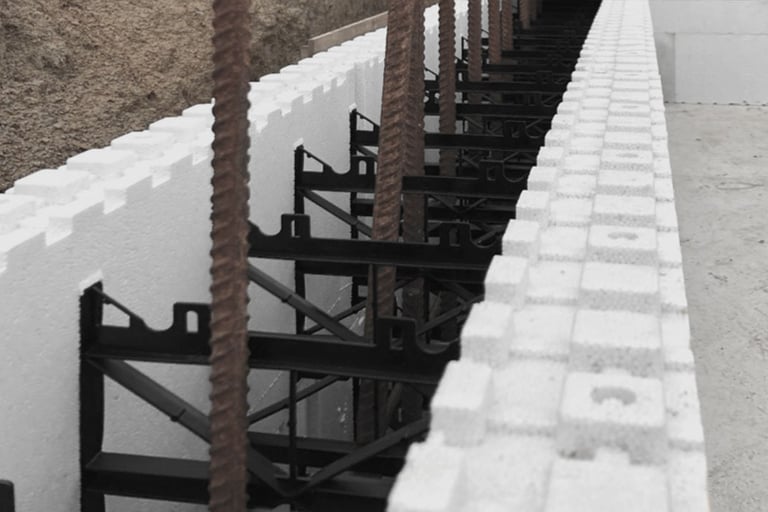
To make a concrete wall perform well in a cold or mixed climate, it usually needs to be paired with a good insulating system. That is one reason why insulated concrete form construction makes so much sense. In that system, the concrete is enclosed within insulation. The concrete remains part of the structural and thermal strategy, but the insulation greatly slows heat loss and heat gain.
The result is very different from a bare concrete wall.
When the concrete is protected within insulation, the warmth generated indoors can remain inside far longer, and outside cold has far less ability to penetrate through and influence the interior. In that situation, the mass and the insulation work together instead of fighting each other.
That is where good design begins.
Where thermal mass works best
Thermal mass performs best where temperature swings are wide and predictable.
A classic example is an earth-built or thick-walled masonry house in a hot climate, especially one where the days are very hot and the nights cool down sharply. In that situation, the walls absorb heat during one part of the cycle and release it during another, helping to moderate the indoor environment.
The effectiveness comes not just from the material, but from the conditions.
Very thick earth walls, for example, are not thick simply because they need strength. Their thickness helps slow and regulate the movement of temperature through the wall. The thicker the wall, the longer it takes for heat or coolness to move through it.
That delay is what gives thermal mass its value.
In the right climate, this creates comfort naturally and with relatively little mechanical assistance. In the wrong climate, or in the wrong wall system, the same material may not perform nearly as well as people expect.
Why many people overstate thermal mass
Part of the reason thermal mass is spoken about so freely is that it sounds scientific and reassuring. It gives the impression of a house that somehow manages heat automatically and efficiently.
But the truth is more precise.
Thermal mass is useful when:
the material is substantial enough
the climate suits it
the design makes use of the day-night cycle
and the building is insulated in the right way where needed
Thermal mass is far less useful when:
the wall is too thin
the material is exposed directly to unwanted outside temperatures
the building loses heat too quickly
or the climate does not support that natural cycle well
A common mistake is to treat thermal mass as though it were always desirable in the same way. It is not. Like every building principle, it works best when it is used intelligently and in the right context.
Efficiency is a bigger picture
A truly efficient home is not created by one property alone.
It is the result of several things working together:
insulation
airtightness
structural design
controlled ventilation
intelligent use of mass
quality of materials
climate-appropriate detailing
A house can have impressive thermal mass and still be inefficient.
A house can be well insulated and still feel poor to live in if the design is careless.
The best-performing homes are not built around slogans. They are built around understanding how different materials behave and how different principles support each other.
Why this matters in Atlas Dome Homes
This distinction is important to Atlas Dome Homes because our goal is not only to build strong houses, but to build homes that are practical, comfortable, and efficient in real use.
That is why the structure matters, but the insulation strategy matters just as much.
Our walls use insulated concrete forms so that the concrete structure is paired with effective insulation from the start. The dome system provides strength and long-term durability, but we do not stop there. The roof system is also treated with great importance, because so much heat is lost or gained through the roof if it is not properly designed.
Between the concrete dome and the outer roof structure, we use our lightweight insulating cementitious mix to help reduce that heat transfer and improve performance where it matters most.
The aim is not simply to use concrete and assume that mass alone will solve the problem. The aim is to combine structural strength with sensible thermal design.
That is the difference.
Understanding the real mechanics
The mechanics of thermal mass are not difficult, but they are often oversimplified.
A heavy material can store heat, yes. But the real question is whether that stored heat stays where you want it, for as long as you want it, under the climate conditions you are dealing with.
That depends on thickness, insulation, temperature swing, exposure, and the overall building system.
Without those things working together, thermal mass is often talked about far more confidently than it is understood.
And that is exactly why the subject deserves clearer thinking.
A more sensible approach
Thermal mass has a place in good building.
So does insulation.
So does structural strength.
The mistake is to imagine that one of them can do the work of all the others.
The best homes are not built by choosing between thermal mass and efficiency. They are built by understanding when mass helps, when insulation matters more, and how the two should work together.