What Matters Most in a 21st-Century Home
What matters most in a home today goes far beyond appearance or upfront cost. Durability, efficiency, maintenance, resilience, and long-term value are now central to how thoughtful homeowners compare housing choices.
Carlos DaCosta
4/8/20264 min read
Why durability, efficiency, resilience, and long-term value matter more than ever
For much of the last century, many people judged a house by a relatively narrow set of standards. If it looked attractive, was built in the accepted way, and could be completed at a reasonable cost, that was often enough. Strength, maintenance, durability, and long-term efficiency were considered, but not always with the seriousness they deserve.
Today, that is changing.
More people are beginning to ask deeper questions about the homes they live in and the homes they hope to build. They are thinking not only about appearance or floor area, but about how a house will perform over time, how much it will cost to maintain, how well it will handle extreme weather, how efficient it will be to live in, and whether it is truly built for modern conditions.
That shift in thinking is both sensible and necessary.
The world around housing has changed
Homes are no longer being judged in the same world in which many accepted building habits first became standard.
Energy costs have risen. Severe weather has become a greater concern. Repair and replacement costs have increased sharply. Families are more aware of how quickly apparently ordinary problems—water intrusion, poor insulation, material deterioration, roof failure, storm damage, or fire—can turn into major expense and disruption.
At the same time, there is a growing sense that many products in modern life are made more for turnover than for longevity. People see it in appliances, in vehicles, in consumer goods, and increasingly, they see it in housing as well.
That naturally leads to a different question:
What should matter most in a house today?
Looking beyond first cost
For many years, housing decisions have often been led too heavily by initial cost and speed of construction. Those things matter, of course, but they are only part of the picture.
A house that is quick and cheap to build may later demand:
higher energy bills
more maintenance
more frequent repairs
shorter replacement cycles
and greater vulnerability to weather and wear
When looked at over twenty, thirty, or fifty years, the cheapest house at the beginning is not always the most economical house in the end.
That is why more people are beginning to think in terms of total performance rather than first appearance or first cost alone.
The factors that matter most now
A 21st-century home should be judged by a broader and more realistic standard.
Among the most important questions are these:
1. How durable is the structure?
Will the main shell of the house last well with time, weather, and ordinary use? Or is it highly dependent on frequent repair and protection?
2. How much maintenance will it require?
Some buildings demand constant upkeep simply because the materials are more vulnerable. Others are more forgiving and more stable over time.
3. How efficient is it to live in?
Efficiency is not only about heating equipment or insulation labels. It is about how the whole structure performs together: walls, roof, thermal behavior, and the ability to reduce wasted energy over the life of the home.
4. How resilient is it in severe conditions?
Storms, fire risk, moisture, heat, cold, and sudden weather extremes are all part of modern reality. A home should not be judged only by how it performs on a pleasant day.
5. How comfortable is it?
Comfort matters. Not only visual comfort, but acoustic, thermal, and emotional comfort—the sense that a house feels solid, dependable, and calm.
6. How well does it hold long-term value?
A home is one of the largest investments most people ever make. Long-term value depends not only on market fashion, but also on build quality, durability, maintenance burden, and overall performance.
A practical comparison
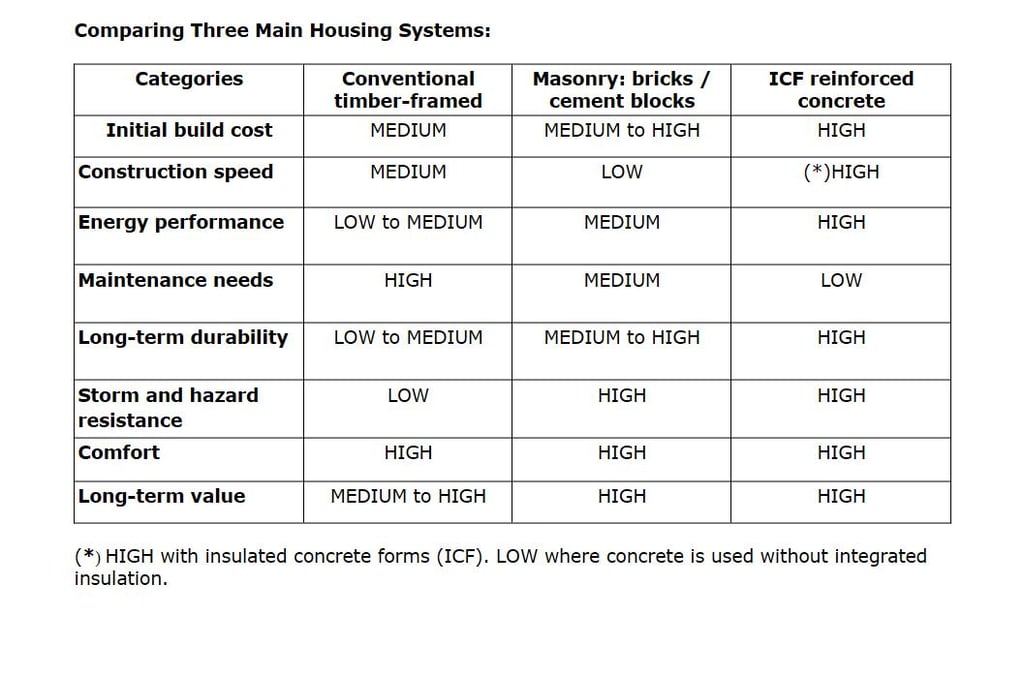
When people compare housing systems seriously, they usually come back to the same practical concerns: cost, speed, efficiency, maintenance, resilience, comfort, and long-term value.
That is why a broad comparison can be useful—not as an absolute rule, but as a way of thinking more clearly about what different building approaches generally offer.
The comparisons in the chart below are a general guide based on practical concerns in single-family housing. Actual performance depends on climate, design, workmanship, maintenance, and location.
What the comparison really shows
A chart like this is useful not because it proves one solution is perfect, but because it reminds people that housing is not one-dimensional.
The best home is not always the one that is quickest to build.
It is not always the one with the lowest upfront cost.
And it is certainly not always the one built simply because “that is how houses are usually done.”
A better house is one that answers modern needs more completely. It is designed not just to exist, but to perform.
Why these questions matter more now
Modern life is asking more from buildings.
People want homes that:
are easier to maintain
stay comfortable with less energy loss
withstand severe conditions better
provide a stronger sense of security
and remain practical and valuable over time
That is not unrealistic. It is simply a more mature way of thinking about home ownership.
The old assumptions are being questioned because the pressures on housing have changed. Climate, cost, risk, and long-term practicality now matter more than ever.
Building better means thinking better
The real issue is not whether one material or one system can solve everything.
The real issue is whether people are comparing houses by the right standards.
If homes are judged only by short-term cost, surface appearance, or speed of construction, important weaknesses can be overlooked.
If they are judged by durability, maintenance, resilience, efficiency, comfort, and long-term value, the conversation becomes much more useful.
That is where better building begins.
A more realistic standard for the future
A 21st-century home should not merely look good on the day it is finished. It should continue to serve well, protect well, and perform well for decades.
That means asking more of materials.
It means asking more of design.
And it means being willing to question what has long been accepted as normal.
The homes that matter most in this century will not simply be those built fastest or cheapest.
They will be the ones built with greater thought, greater honesty, and greater respect for how people really live.